16 years of experience in the warehousing equipment industry
A comprehensive enterprise integrating research and development, production, sales, and installation


WE MAKE RACKING PROFESSIONAL
Specialize in heavy duty rack and mezzanine rack.
Warehouse Racking Selection Guide: Match the Perfect Storage System for Your Business
Start with Your Business Stage & Inventory Features
Before comparing different rack types, you need to clarify your core storage scenarios. Your inventory characteristics are the most fundamental basis for shelf selection.
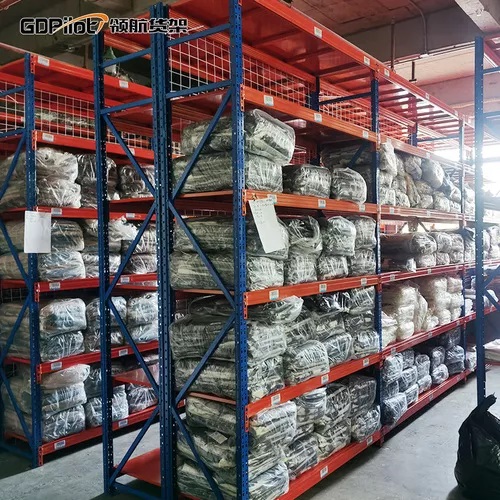
Heavy Palletized Inventory: If your warehouse mainly stores palletized goods, industrial raw materials, finished products, and mechanical equipment with heavy unit weight, standard heavy-duty pallet racking is your first choice. It features strong load capacity, stable structure, and full forklift accessibility, fully adapting to high-intensity industrial storage scenarios.
Multi-SKU Small Parts: For electronics, hardware accessories, spare parts, and packaging materials with various SKUs and small unit volume, medium-duty multi-layer shelves or smart shelving systems are more suitable. They support classified storage and improve the accuracy of manual picking and inventory management.
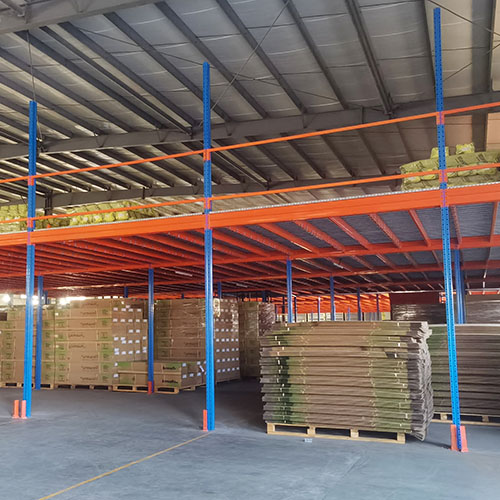
Slow-Moving & Bulk Inventory: For large quantities of low-turnover goods that do not require frequent access, high-density storage solutions such as mezzanine shelving and drive-in racks can greatly improve space utilization and reduce idle warehouse resources.
Match Racking According to Warehouse Space Conditions
Space parameters determine what kind of rack structure can be installed and whether it can exert maximum efficiency. Two key factors cannot be ignored: ceiling height and aisle width.
Ceiling Height Matching: Warehouses with a ceiling height below 3.5 meters are limited in vertical expansion, so medium and light-duty combined shelves are the most economical option. For warehouses with a height of 3.5m to 5m, standard heavy-duty pallet racks can be used to build multi-layer storage spaces. If the ceiling height exceeds 5 meters, building a steel structure mezzanine can double or triple the usable area without factory expansion.
Aisle Width Matching: If your warehouse has narrow aisles and limited moving space, narrow-aisle pallet racks are ideal to save passage space and increase storage density. For conventional warehouses with wide aisles, general selective heavy-duty racks can coordinate perfectly with forklifts and manual handling tools to ensure smooth operation.
Select Racks Based on Daily Operation Mode
Your daily warehouse operation mode directly determines the shelf functional requirements. A rack suitable for forklift operation may be inconvenient for manual work, and vice versa.
Manual Picking Warehouses: Most e-commerce warehouses, accessory warehouses, and workshop material warehouses rely on manual sorting and picking. It is recommended to choose multi-layer flat shelves, mezzanine platforms, and smart picking shelves. These designs reserve safe walking space with moderate height, helping workers complete material access quickly and safely.
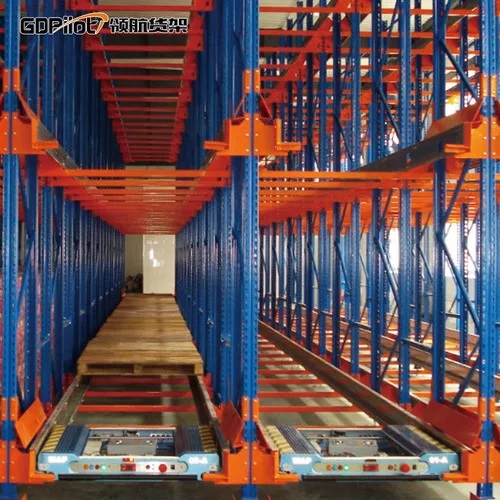
Forklift Operation Warehouses: Large-scale manufacturing warehouses and logistics distribution centers mainly adopt mechanical handling. Heavy-duty pallet racks, drive-in racks, and push-back racks are designed for forklift access, realizing fast loading, unloading and pallet replacement to improve overall warehouse turnover efficiency.
Intelligent Unmanned Warehouses: For enterprises undergoing digital transformation, traditional single-function shelves can no longer meet management needs. Upgrading to IoT-based smart shelving systems can realize automatic inventory counting, abnormal alarm, and data linkage with WMS and ERP systems, greatly reducing manual dependence.
Avoid Common Warehouse Shelving Selection Mistakes
Most warehouse operation problems stem from incorrect shelf selection. Here are the most common mistakes to avoid:
Blind pursuit of low price: Low-cost non-standard racks usually have thin materials, insufficient load capacity, and poor welding quality, which are prone to deformation and collapse, bringing huge safety hazards.
Unmatched load capacity: Using light shelves to store heavy goods will cause structural bending, while using heavy racks for light goods will cause cost waste.
Ignoring future scalability: Fixed non-modular shelves cannot be adjusted or expanded. With business growth, warehouses will face secondary renovation and repeated investment.
Neglecting safety configuration: Lack of column protectors, safety pins, guardrails and other accessories will greatly increase the risk of collision and falling accidents.
Balance Budget, Safety and Long-Term Value
Excellent warehouse racking solutions need to balance budget control, operational safety and long-term scalability. When selecting shelving systems, enterprises should not only focus on upfront costs but also consider service life, maintenance costs and space improvement benefits.
Standard industrial-grade racks adopt high-quality steel and anti-rust electrostatic spraying technology, with a service life of more than 10-15 years. The modular assembly structure supports free adjustment, disassembly and reorganization, which can adapt to business changes and bring sustainable value to warehouse operation.
In addition, qualified racking systems comply with international industrial safety standards, with scientific structural stress design and complete safety protection measures, effectively protecting employees, goods and warehouse facilities.
Final Words
Choosing the right warehouse racking is the first step to standardized and efficient warehouse management. The best storage solution is not the most high-end or expensive one, but the one that suits your inventory characteristics, space conditions, operation modes and budget. By conducting reasonable planning and scientific selection, you can maximize warehouse space utilization, optimize operational efficiency, reduce comprehensive costs, and create stable support for enterprise supply chain development.