16 years of experience in the warehousing equipment industry
A comprehensive enterprise integrating research and development, production, sales, and installation


WE MAKE RACKING PROFESSIONAL
Specialize in heavy duty rack and mezzanine rack.
Cantilever Racks: Professional Solution for Efficient Storage of Long Materials
I. What are Cantilever Racks?
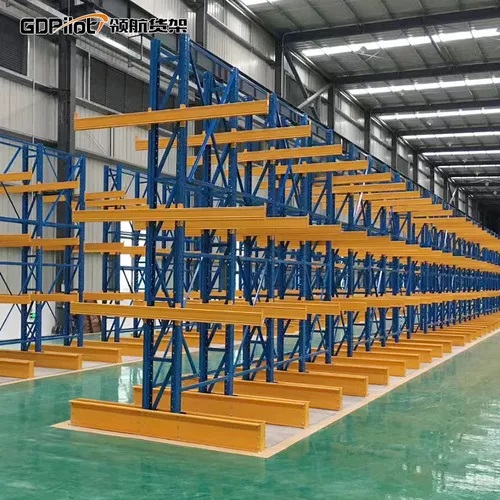
Cantilever racks are a type of heavy-duty warehouse racks. Their core structure consists of four parts: column base, column, cantilever,
and support tie rod. Abandoning the shelf design of traditional racks, they use cantilevers extending on one or both sides
as the main load-bearing body, specifically for storing long and irregular goods.
The entire rack is made of high-quality cold-rolled steel through bending, welding and spraying processes, with a stable structure
and strong load-bearing capacity. It can be flexibly customized according to the length, weight and storage capacity of materials,
and is the core equipment for professional and standardized storage of long materials in industrial warehousing.
II. Core Structure and Classification of Cantilever Racks
1. Core Components
Column Base: Supports the entire rack, increases the contact area with the ground,
ensures the stability of the rack and prevents tipping;
Column: The vertical support main body of the rack, adopting a thickened steel structure,
bearing the total weight of the cantilever and goods;
Cantilever: The core load-bearing component of the rack, divided into single-arm and double-arm, with adjustable spacing,
directly supporting long materials;
Support Tie Rod: Connects the front and rear columns, enhances the overall rigidity of the rack,
avoids cantilever deformation under force, and improves safety.
2. Main Classifications
According to the usage scenarios, structure and load-bearing capacity, cantilever racks can be divided into three categories:
Light-duty Cantilever Racks: Light load-bearing, suitable for light long materials such as aluminum profiles,
plastic profiles and small-diameter pipes, mostly used for semi-finished product storage in workshops;
Medium-duty Cantilever Racks: Moderate load-bearing, the most versatile, suitable for wood, building materials,
medium-sized pipes, etc., and is the mainstream choice in the market;
Heavy-duty Cantilever Racks: Made of extra-thick steel, the single-arm load-bearing can reach more than 500kg,
suitable for ultra-heavy long materials such as heavy steel pipes, I-beams and large plates, adapting to heavy industrial warehousing.
In addition, according to the cantilever direction, it can be divided into single-sided cantilever racks (placed against the wall to save space)
and double-sided cantilever racks (placed in the middle of the channel to double the storage capacity).
III. Core Advantages of Cantilever Racks
Strong Targeted Adaptability to Irregular Materials Specifically designed for long, strip, tubular and plate materials,
it perfectly solves the pain point that ordinary racks cannot store ultra-long and irregular goods.
Materials can be directly placed on the cantilever without cutting or splitting.
Maximized Space Utilization Layered storage in the vertical direction makes full use of the warehouse height;
the cantilever spacing can be freely adjusted, and the layout can be flexibly arranged according to the material size.
Compared with ground stacking, the space utilization rate is increased by 3-5 times.
Efficient Access and Convenient Management Goods are classified and placed in layers with clear labels.
With the cooperation of forklifts and stackers, fast access can be realized without rummaging,
which greatly improves the efficiency of warehouse operations and reduces labor costs.
Protect Materials and Reduce Loss Avoid deformation, scratch and bending caused by stacking materials on the ground, especially for metal profiles, precision building materials and other materials, which can effectively ensure the integrity of materials.
Stable Structure and Safe and Reliable Thickened steel + integral welding + electrostatic spraying, with strong load-bearing capacity, corrosion resistance and not easy to deform; equipped with anti-fall and anti-slip accessories, in line with warehouse safety standards.
Flexible Customization and Wide Adaptability The cantilever length, number of layers, height and color can be customized according to the warehouse area, material size and load-bearing requirements, adapting to various storage scenarios such as factories, warehouses and stores.
IV. Application Scenarios of Cantilever Racks
Cantilever racks have a wide range of application scenarios, covering the long material storage needs of multiple industries:
Building Materials Industry: Wood, plates, gypsum boards, aluminum profiles, plastic steel doors and windows, PVC profiles;
Hardware Processing: Steel pipes, steel bars, I-beams, angle steels, stainless steel pipes, metal bars;
Logistics Warehousing: Long goods transshipment, cable coils, pipe logistics warehouses;
Manufacturing Industry: Auto parts, long mechanical processing materials, plastic profiles, FRP products;
Supermarkets/Stores: Sample display and goods storage in building materials markets and hardware stores.
V. Key Points for Purchasing Cantilever Racks
Clarify the Load-bearing Requirement: Select light-duty, medium-duty or heavy-duty racks according to the weight of a single material to avoid overloading;
Measure Material Size: Determine the length, diameter/thickness of the material, and customize the appropriate cantilever length and rack height;
Consider the Warehouse Environment: Choose single-sided cantilevers for wall placement, double-sided cantilevers for channel placement, and prioritize compact size customization for small warehouses;
Pay Attention to Material Technology: Prefer high-quality cold-rolled steel with standard wall thickness, flat welding, uniform spraying, corrosion resistance and strong load-bearing capacity;
Match Access Equipment: If forklifts are used for operation, reserve sufficient channel space to ensure convenient operation.
VI. Notes on Installation and Use of Cantilever Racks
Installation must be operated by professional personnel, fix the base and tie rods to ensure the rack is level and stable;
Follow the principle of heavy load at the bottom and light load at the top when placing goods, place heavy materials on the lower cantilevers and light materials on the upper cantilevers;
It is forbidden to store goods beyond the load capacity and cantilever length to avoid cantilever deformation and rack tipping;
Regularly check whether the welding joints and connectors of the rack are firm, and maintain damaged parts in time;
Handle goods with care when accessing to avoid violent impact on the cantilever and extend the service life of the rack.
Conclusion
With the characteristics of specialization, efficiency, stability and flexibility, cantilever racks completely solve the warehousing problems of long and irregular materials. They not only optimize the warehouse space, but also improve the efficiency of warehouse management, and are essential equipment for long material storage in various industries. Whether it is a small building materials store or a large heavy industrial warehousing center, customized cantilever racks can be used to achieve efficient use of warehouse space and standardized management of materials.
Choose the suitable cantilever racks to make long material storage more orderly, operations more efficient and costs more controllable!
Summary
This article comprehensively introduces the definition, structure, classification, core advantages, application scenarios, purchasing and use specifications of cantilever racks, clearly answers the pain points of long material warehousing. The content is professional and easy to understand, suitable for reference by enterprise purchasers, warehouse managers and industry practitioners, and can be directly published on enterprise official websites, industry platforms, product promotion and other webpage scenarios.